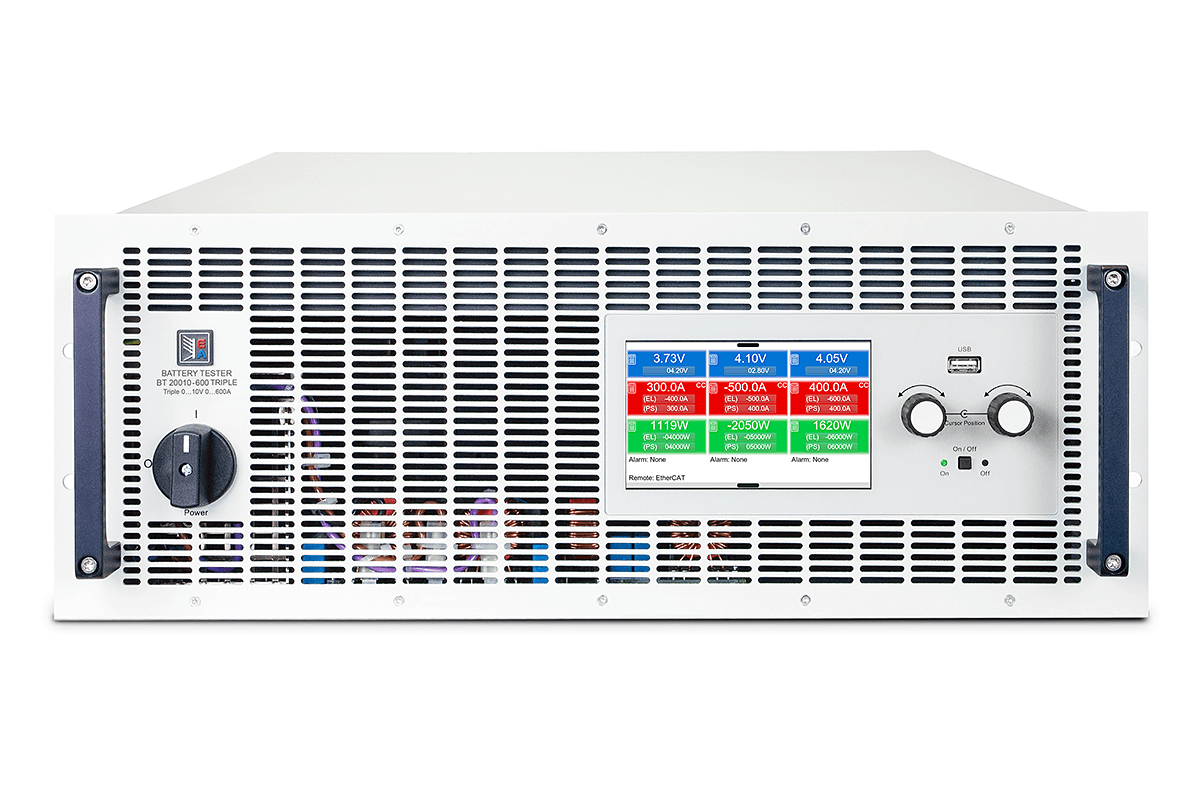
What it is
The EA-BT 20000 Triple 4U is a two-quadrant battery tester with regenerative energy recovery that puts three independent test channels in one 4U unit: each channel both charges and discharges a battery, feeding discharge energy back to the grid at up to 96% efficiency. Autoranging output stages cover 0–10 V to 0–920 V and ±40 A to ±600 A per channel, with integrated battery-test functionality, CC-CV discharge characteristics, and an amp-hour counter. The three channels can also be grouped as one channel of up to 30 kW and 1800 A. A single-channel version, the EA-BT 20000 single-channel series, is available for higher per-channel power up to 30 kW.
- Three independent channels — three two-quadrant test channels in one 4U unit, each charging and discharging (positive and negative current)
- Regenerative discharge — recovers energy to the grid at up to 96% efficiency
- Power: up to 10 kW per channel; up to 30 kW and 1800 A with the three channels grouped
- Output classes: 0–10 V to 0–920 V; 0–40 A to 0–600 A per channel, model-dependent
- Integrated battery-test functionality — CC-CV discharge characteristics, amp-hour counter, alarm and warning management; battery simulation optional
- Autoranging constant-power output — full rated power across a wide voltage and current envelope
- Precise digital control — CV, CC, CP with fast crossover; 18-bit high-resolution regulation with selectable controller speed (normal, fast, slow); 1 ms communication
- Built-in interfaces — USB, Ethernet 1 Gbit/s, EtherCAT, CAN FD, plus a per-channel 16-pole Digital In/Out; SCPI and ModBus with LabVIEW and IVI drivers
- Wide dual-range 3-phase input — 208 V or 380–480 V, auto-adjusting (30 kW models derate on a 208 V grid)
- Parallel operation via galvanically isolated Share-Bus and Master-Auxiliary bus for multi-unit systems
Three channels, two-quadrant operation with energy recovery
The BT 20000 Triple is a two-quadrant device with three channels: each channel acts as a charger (source) and as an electronic load (discharge) from the same terminals, driving positive and negative current, so one unit runs complete charge/discharge cycles on three batteries at once, or on one battery with the channels grouped, without a separate supply and load.
In discharge mode the device is regenerative: the energy drawn from the battery is converted back to AC and fed into the local grid at up to 96% efficiency, rather than dissipated as heat. Two costs fall as a result — energy cost, because the discharge energy is recovered rather than wasted, and cooling cost, because the unit generates far less heat and needs less air conditioning. One device can be sufficient for a wide range of applications, reducing investment and installation cost.
The principle of autoranging
A conventional tester reaches full power at only one voltage-current point. Each BT 20000 Triple channel uses a flexible, power-regulated output stage (autoranging) that maintains full rated power across a wide range of voltage and current combinations, in both charge and discharge directions. One channel covers a working area that would otherwise require several fixed-rating instruments.
The result is a constant-power characteristic: as terminal voltage falls, the available current rises to hold the same wattage, on both the charge and discharge sides of the curve. For deep-discharge work this reaches down to very low voltages, with the high load current allowing maximum total discharge even below 2 V.
What it tests and simulates
Battery test for electro mobility. Tests the electrical characteristics of batteries across cell, module, and pack level, including State-of-Health (SOH) determination for second-life classification and end-of-line (EOL) test. Suits both standalone automatic test systems and integrated battery test, with the measurement accuracy, reproducibility, and reliability the application demands.
Battery simulation (optional). With the EA Battery Simulator option, the tester simulates batteries as single cells, modules, or packs to support the development of energy storage and the components powered by it. Used as a simulator, it also protects the connected component: overcurrent protection acts like a safety fuse, switching off and raising an alarm, while voltage monitoring can trigger functions and warnings when limits are crossed.
Battery recycling. Assesses retired EV batteries for second-life use, starting from an amp-hour-based State-of-Health check. Where too little capacity remains, autoranging allows full discharge before recycling, down to voltages under 2 V via the high load current, while regeneration to the grid at up to 96% efficiency keeps the process cost-effective.
Why engineers pick it
Three independent channels in one 4U. Three two-quadrant channels of up to 10 kW each charge and discharge separate batteries at once, or group into one channel of up to 30 kW and 1800 A — three test points, or one high-current point, from a single 4U unit.
Recovers discharge energy instead of wasting it. Regeneration returns energy to the grid at up to 96% efficiency, cutting both energy cost and the heat load that would otherwise drive air-conditioning cost.
Battery-test intelligence built in. Integrated battery-test functionality, CC-CV discharge characteristics, and an amp-hour counter, with 18-bit high-resolution digital regulation and 1 ms communication for fast, reproducible sequencing.
Precise, wide-range measurement. Voltage measurement accuracy to ≤0.05% FS and current to ≤0.1% FS across output classes from 0–10 V to 0–920 V per channel, reaching below 2 V for deep-discharge work.
Built-in test and control
Beyond source and sink, the BT 20000 Triple integrates typical battery-tester functionality so much of a test system lives in the device itself: CC-CV discharge characteristics, an amp-hour counter, and alarm and warning management. The unit is operated from a TFT control interface with rotary knobs, and the front-panel USB host logs data and runs sequences directly from a USB stick.
Control and monitoring extend through a Digital In/Out connector per channel — three universal, user-configurable inputs, three dry-contact outputs, and three temperature-sensor inputs — for battery control and false-polarity protection, so cell and pack temperatures feed the test alongside voltage and current. All communication interfaces (USB, Ethernet 1 Gbit/s, EtherCAT, CAN FD) are galvanically isolated from the DC side, with command support for SCPI and ModBus and LabVIEW and IVI drivers.
Grouping channels and scaling to high-power systems
To reach higher power and current, the three channels group internally: connected in parallel externally, they run as one channel of up to 30 kW and up to 1800 A. As an example, one device builds a cell tester with three channels of 0–10 V and 0–600 A, or one channel of 0–10 V and 0–1800 A.
For still higher power, units connect in parallel through rear copper blades and horizontal copper rails, with a contact-protection cover on every channel. The galvanically isolated Master-Auxiliary bus lets the combined system behave as one device — total power and total current are reported on the master, and auxiliary-unit warnings and alarms appear in its display — while the Share-Bus distributes load equally across the connected units. Paralleling multiple BT 20000 devices with vertical copper rails builds high-power battery test systems up to 240 kW in a single 19-inch 42U cabinet, occupying roughly 0.6 m² (6.5 sq ft) of floor space.
Choosing your configuration
This page covers the triple-channel BT 20000, three test channels of up to 10 kW each in one 4U unit. If you need higher per-channel power, up to 30 kW in a single channel, see the separate EA-BT 20000 single-channel series.
Select the output class by voltage and current per channel:
- Eight output classes. 0–10 V / 0–400 A and 0–10 V / 0–600 A for high-current cell work; 0–60 V and 0–80 V / 0–340 A for modules and low-voltage packs; 0–200 V / 0–140 A and 0–360 V / 0–80 A for mid-voltage packs; 0–500 V / 0–60 A and 0–920 V / 0–40 A for high-voltage EV packs. Enclosure 483 mm (19 in) × 177 mm (4U) × 668 mm (26.3 in); overall depth from 802 mm (31.6 in). 50 kg (110 lb).
Then choose options:
- Water cooling in stainless steel — 56 kg (126 lb).
- EA Battery Simulator for cell, module, and pack simulation.
The dual-range input accepts 208 V or 380–480 V and adjusts automatically without configuration; on a 208 V grid the 30 kW models set a DC-power derating.
Configure your BT 20000 Triple 4U on this page — output class and cooling — then add to cart or request a quote. For multi-unit parallel systems and cabinet integration, contact W5 Engineering.