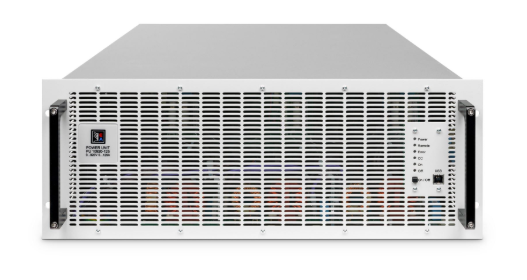
What it is
The EA-PU 10000 is a three-phase programmable DC power supply for test benches, component testing, source simulation, and process power. Autoranging output stages hold full power (30 kW in the 4U chassis, 60 kW in the 6U) across a wide voltage and current range from a single unit, and up to 64 units parallel over Master-Slave and Share-Bus into systems reaching 3840 kW and 64000 A.
- Power per unit: 30 kW (PU 10000 4U) or 60 kW (PU 10000 6U)
- Output classes: 0–60 V / 0–1000 A up to 0–2000 V / 0–40 A, model-dependent
- Autoranging constant-power output — full rated power across a wide V/I envelope, not only at a single operating point
- Regulation modes: CV, CC, CP, CR with fast crossover; digital control with 16-bit ADCs and DACs
- Efficiency up to 96%, active power factor correction, power factor typically 0.99
- Wide-range 3-phase input: 380–480 V ±10% (4U also accepts 208–240 V ±10%, derated to 18 kW)
- Parallel operation to 64 units via Master-Slave bus and galvanically isolated Share-Bus
- Built-in USB, Ethernet, and analog interfaces; SCPI and ModBus command sets with LabVIEW and IVI drivers
The principle of autoranging
A conventional DC supply reaches full power at only one voltage-current point. The PU 10000 uses a flexible, power-regulated output stage (autoranging) that maintains full rated power across a wide range of voltage and current combinations. One unit covers a working area that would otherwise require several fixed-rating supplies.
The result is a constant-power characteristic: as output voltage falls, available current rises to hold the same wattage. A single 30 kW 4U unit, for example, sources its full power from a high-voltage/low-current operating point down through a low-voltage/high-current point along one continuous curve. Because the output stage is regulated rather than fixed, the same unit serves multiple test articles and set-points without re-racking hardware.
What it powers, tests, and simulates
Fuel cell simulation. Reproduces fuel-cell energy sources for testing the cell and the components it powers. Built-in protection behaves like a safety fuse, with overcurrent protection able to switch off the output and raise an alarm, while voltage monitoring triggers functions and warnings when limits are crossed.
Power supply for electrolysis. Serves as an energy source for green-hydrogen electrolysis. Systems up to 3.84 MW can be built by parallel connection in air- or water-cooled versions, operating in CC, CP, or CV mode with the accuracy and dynamics the process requires.
Electric-vehicle component testing. Tests fuses, relays, traction inverters, and DC-DC converters. The optional function generator maps real load profiles so components see realistic conditions, and autoranging keeps one supply flexible across a broad component set.
Solar array simulation. Drives PV-inverter test with solar-panel simulation to EN 50530 or Sandia models, accounting for irradiation, panel technology, and temperature. 16-bit resolution and a high sampling rate produce accurate, documentable results that can be saved to an Excel file.
Relay test in production. Supplies defined voltage and current for coil and contact tests, covering operate, hold, and decay current, contact resistance, voltage consistency, and disconnect threshold. Its precise, dynamic control of voltage, current, power, and resistance integrates into automatic test systems without added measuring equipment.
Why engineers pick it
One unit covers a wide operating envelope. Autoranging output stages hold full 30 kW or 60 kW across a broad voltage and current range, so a single supply replaces several fixed-rating units and adapts as the test set-point moves.
High efficiency with clean mains loading. Efficiency up to 96%, an active PFC holding power factor near 0.99, and leakage current below 10 mA keep energy draw and grid impact low across the series.
Precise digital regulation. 16-bit ADCs and DACs, CV/CC/CP/CR modes with fast crossover, and selectable voltage-control speed (Normal, Fast, Slow) deliver load regulation to ≤0.05% FS in CV and rise/fall times of ≤10 ms (CV) and ≤2 ms (CC).
Scales to megawatt systems as one unit. Up to 64 units combine over Master-Slave and Share-Bus into a single addressable system, up to 1920 kW with 30 kW 4U units and up to 3840 kW and 64000 A with 60 kW 6U units.
Scaling to high-power systems
For higher power and current, units connect in parallel through the rear copper rails; a contact-protection cover is provided. The Master-Slave bus lets the combined system behave as one device, with total power and total current reported on the master and slave-unit warnings and alarms appearing in its display, while the Share-Bus distributes load equally across the connected units.
A 19 in cabinet with 42U provides a 300 kW system in roughly 0.6 m² (6.5 sq ft) of floor space. The Master-Slave bus supports up to 13 cabinets and a maximum of 64 units. Power classes can be mixed from 5 kW upward provided the voltage class stays constant, so a 150 kW system can be built from two 60 kW 6U units and one 30 kW 4U unit.
Choosing your configuration
Select the chassis by power, then the output class by voltage and current:
- PU 10000 4U — 30 kW. Ten output classes from 0–60 V / 0–1000 A up to 0–2000 V / 0–40 A. Enclosure 19 in × 4U × 668 mm (26.3 in), 50 kg (110 lb). Accepts 380–480 V or 208–240 V (derated to 18 kW).
- PU 10000 6U — 60 kW. Seven output classes from 0–360 V / 0–480 A up to 0–2000 V / 0–80 A. Enclosure 19 in × 6U × 668 mm (26.3 in), 76 kg (168 lb). Accepts 380–480 V.
Then choose options:
- Water cooling in stainless steel, adding weight to 56 kg (126 lb) on the 4U or 82 kg (180 lb) on the 6U.
- Function generator for load-profile and simulation work.
- Interface card — CAN, CANopen, RS232, Profibus, EtherCAT, or single/dual-port Profinet, Modbus, or Ethernet, in addition to the built-in USB, Ethernet, and analog interfaces.
Configure your PU 10000 on this page — chassis, output class, cooling, and interface — then add to cart or request a quote. For multi-unit parallel systems, cabinet integration, and Share-Bus builds, contact W5 Engineering.
Buy the EA-PU 10000 through W5 Engineering
W5 Engineering is your authorized North American distributor for EA Elektro-Automatik. Configure and order the PU 10000 directly on this page, with W5 support for output-class selection, parallel-system design, interface and cooling options, integration, and availability.