What it is
A dual-channel or triple-channel wide-range programmable switching DC power supply with up to 1,080 W of total output, built from 360 W multi-range modules rated 30 V to 800 V.
Second to none, dominating mid/low power ranges
Each channel is an independent 360 W multi-range module, rated at 30 V, 40 V, 80 V, or 160 V (low voltage) or 250 V or 800 V (high voltage). Channels built on the same voltage module output in sync, with less than 0.1 ms latency between them.
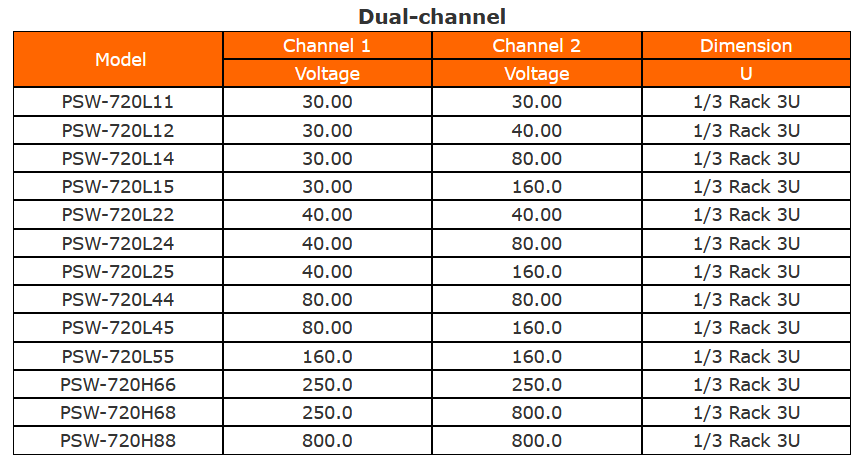
- Dual-channel models: 720 W, 1/3 rack, 3U (13 combinations)
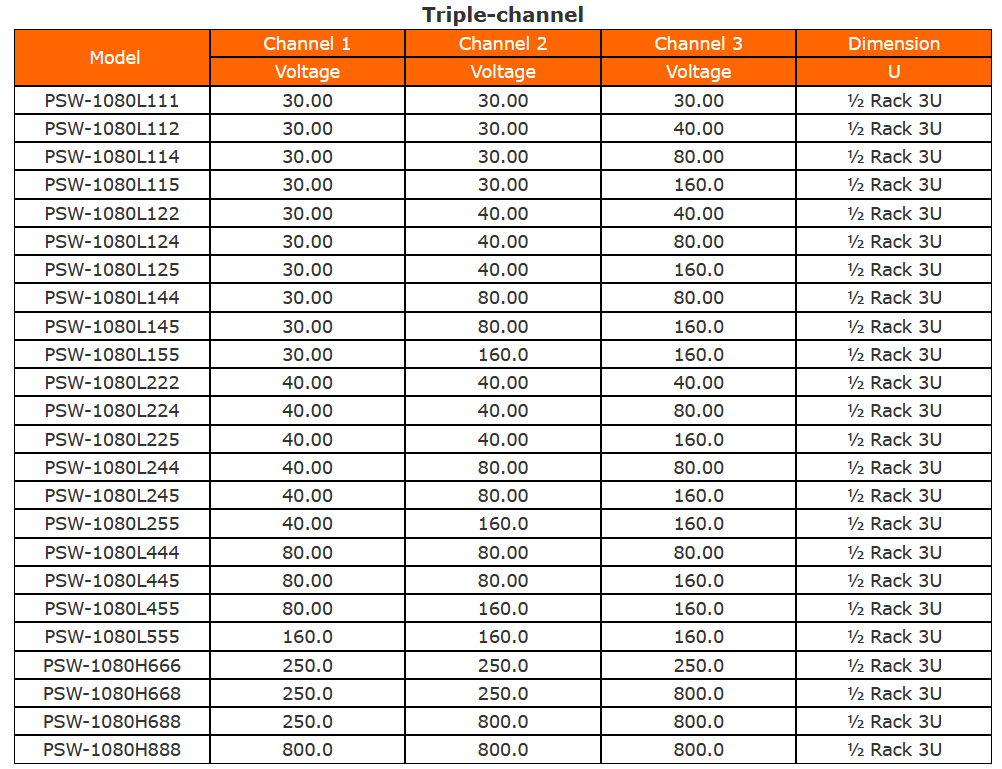
- Triple-channel models: 1,080 W, 1/2 rack, 3U (24 combinations)
- Six output modules: 30 V/36 A, 40 V/27 A, 80 V/13.5 A, 160 V/7.2 A, 250 V/4.5 A, 800 V/1.44 A (360 W each)
- Multi-range (wide-range) output: a wide range of voltage/current combinations at the same rated power
- Synchronous multi-channel output: less than 0.1 ms latency between channels with the same voltage module
- CV/CC priority mode and adjustable voltage/current slew rate
- Advanced web server: SCPI commands, data log, and sequence editing from a browser
- Protection: OVP and OCP (default 110% of rated), OTP, AC fail
- Interfaces: USB host/device and LAN standard; GPIB-USB adapter and RS-232-USB cable optional; analog control/monitoring connector
What it is used for
Some of the use cases for the PSW-Multi Series include:
- Electronics product development and testing
- Automated production lines
- Laboratory equipment driving and industrial control systems
- Automotive electronic testing
- Multi-channel digital device testing, electronic circuit verification, and battery charging and discharging testing
- LED I-V curve verification and manufacturing tests of lighting devices and large capacitors, etc.
What does the PSW-Multi Series do?
The PSW-Multi Series is a dual-channel or triple-channel wide-range output programmable switching DC power supply, with a maximum output power of 1,080 W. There are 13 dual-channel models with a rated power of 720 W, and 24 triple-channel models with a rated power of 1,080 W. The rated voltages of the low voltage modules are 30 V, 40 V, 80 V, and 160 V; the high voltage modules are 250 V and 800 V.
When single-channel supplies are combined for multi-voltage testing, different delays and slew rate settings lengthen voltage output delay and reduce control. Three units paralleled through a backplane for synchronized output each show roughly 5 to 10 ms of latency. The PSW-Multi Series' built-in synchronous output control function (F130) holds latency between channels with the same voltage module below 0.1 ms.
The special functions are as follows
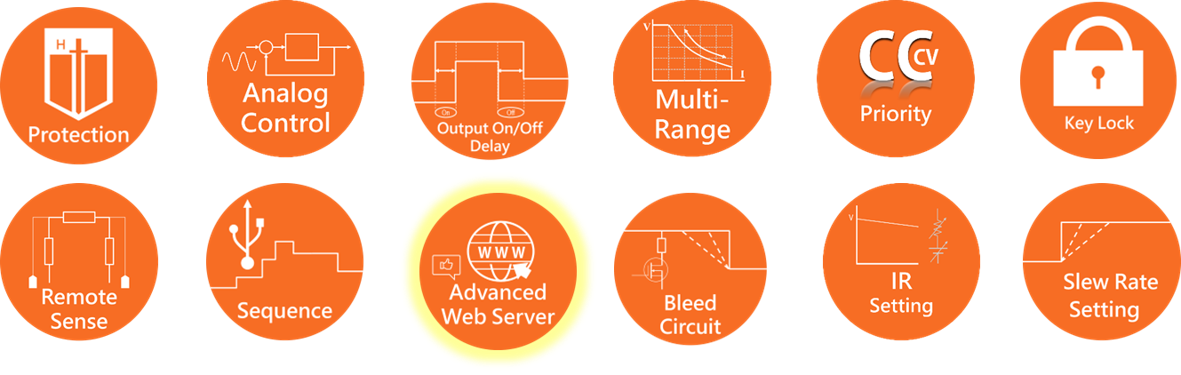
- The advanced web server, a unique function of the PSW-Multi Series, can directly execute SCPI commands on the server and control the PSW-Multi power supply. The data log has an interval of 1 second, and it can edit output sequences.
- Wide-range output: provides a wide range of voltage/current outputs under the same rated power. One power supply has the total capability of multiple power supplies.
- Bleed circuit: accelerates the voltage fall time.
- Sequence: saves the output sequence on a USB flash drive to directly control the power supply to execute the automatic test sequence.
- The CC/CV priority mode of PSW-Multi is a very useful feature for protecting the DUT. Conventional power supplies usually operate in CV mode when outputting. During power output, capacitive loads or current-intensive loads can cause inrush currents. Taking the I-V verification curve of an LED as an example, it would be challenging to measure it using a conventional power supply. In the initial state, a conventional power supply operates in CV mode. When the output voltage exceeds the forward voltage of the LED, the current will instantaneously flow, surpassing the default current limit value. Even when the current becomes stable after switching to CC mode, the crossover point between CV and CC can still potentially damage the DUT. However, the PSW-Multi Series is capable of operating in CC mode during power output to suppress inrush currents and prevent damage to the DUT when the voltage instantaneously conducts.
- Adjustable slew rate allows users to set the rise and fall times of voltage or current. By controlling the slew rate settings, it becomes convenient to verify the DUT under varying voltage or current conditions. In manufacturing tests for lighting devices or large capacitors, power output often generates significant inrush currents, which can greatly reduce the lifespan of the DUT. To prevent damage caused by inrush currents, a slow voltage output significantly reduces the harm caused by inrush currents, thereby achieving device protection.
- The OVP and OCP functions provided by the PSW-Multi Series can be self-defined, and the default value is 110% of the rated value. When the protection setting is triggered, the output will be turned off to protect the DUT. USB and LAN are standard communications interfaces of the PSW-Multi Series, while GPIB-USB and RS232-USB are optional accessories. All interfaces support the LabVIEW driver and Data Logging PC software.
Why engineers pick it
- Protects the DUT at turn-on. Conventional supplies start in CV mode, so capacitive or current-intensive loads draw a current spike at the CV/CC crossover. The PSW-Multi can start in CC priority to suppress that inrush current.
- Controlled ramps. Adjustable slew rate sets the rise and fall times of voltage or current, so a slow voltage transition reduces surge current in manufacturing tests of lighting devices or large capacitors.
- Several supplies in one box. Two or three independent 360 W multi-range channels replace multiple single-channel supplies, in 1/3 or 1/2 rack width.
- Browser control without software. The advanced web server runs SCPI commands, logs data, and edits sequences from any browser over LAN.
Which PSW-Multi model do I need?
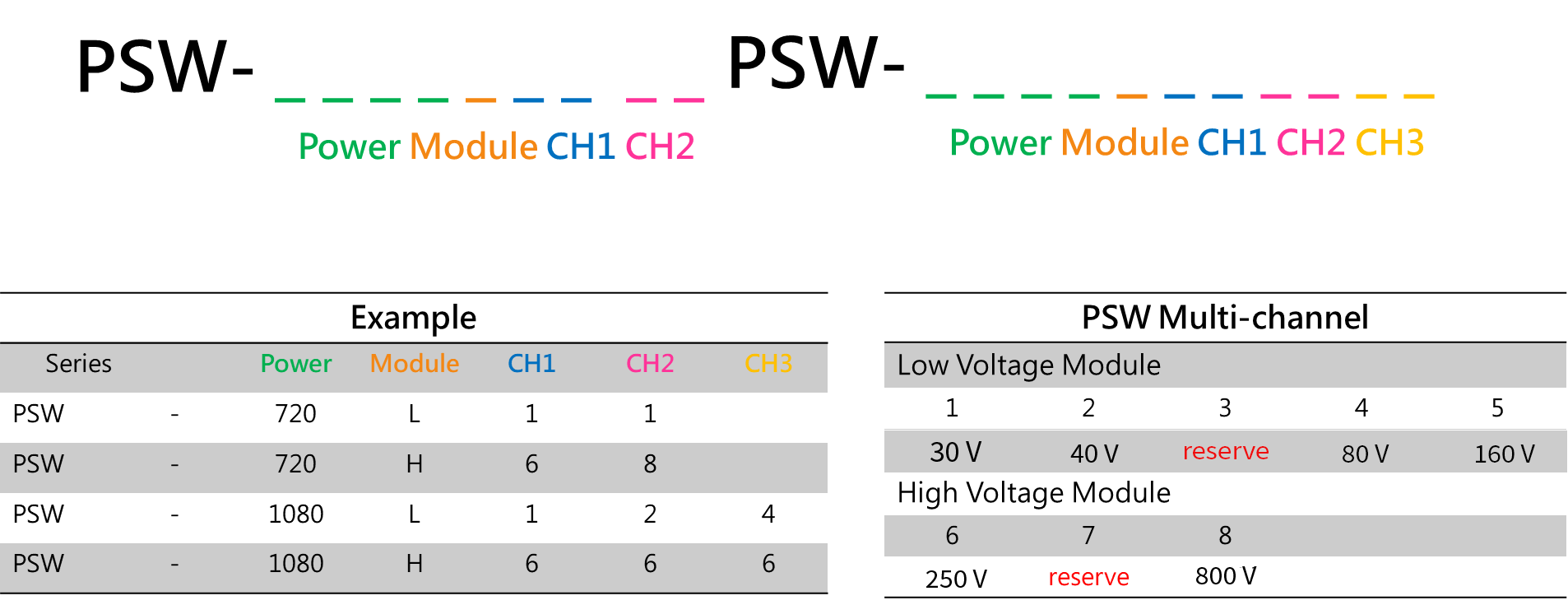
The model number shows the channel modules. "L" models use low voltage modules (1 = 30 V, 2 = 40 V, 4 = 80 V, 5 = 160 V), and "H" models use high voltage modules (6 = 250 V, 8 = 800 V).
| Module code | Rated output | Voltage class |
| 1 | 30 V / 36 A | Low voltage |
| 2 | 40 V / 27 A | Low voltage |
| 4 | 80 V / 13.5 A | Low voltage |
| 5 | 160 V / 7.2 A | Low voltage |
| 6 | 250 V / 4.5 A | High voltage |
| 8 | 800 V / 1.44 A | High voltage |
For example, the PSW-720L14 is a dual-channel model with a 30 V/36 A channel and an 80 V/13.5 A channel, and the PSW-1080H888 is a triple-channel model with three 800 V/1.44 A channels. Thirteen dual-channel and 24 triple-channel combinations are available; the full list is on the Specifications tab.
When is the PSW-Multi the wrong choice?
- More than 360 W on one channel. Each module is rated 360 W; when the requested voltage × current exceeds that, output is limited to the module's operating area.
- Mixing low and high voltage modules. The available models combine low voltage modules (L) or high voltage modules (H), not both in one unit.
- Synchronization across different modules. The <0.1 ms channel-to-channel latency applies to channels with the same voltage module.
- Faster data logging without the license. The web server data log runs at 1-second intervals; 0.1-second logging with direct USB save needs a paid option license key.


