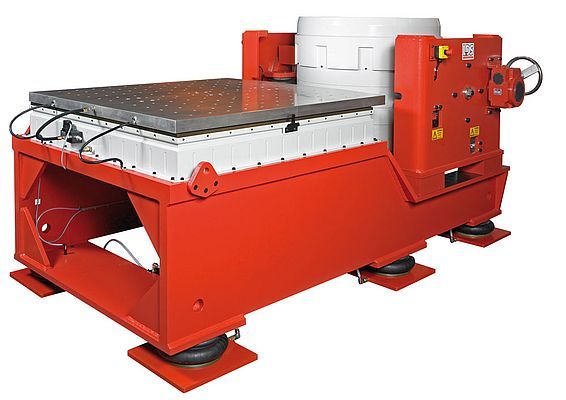
LDS HBT (Hydrostatic Bearing Table) slip tables are oil-film slip tables built on linear hydrostatic bearings for the most demanding horizontal vibration tests. They carry heavy loads with a high center of gravity and high overturning moment. Compared with the LDS LPT series, HBT tables offer higher stiffness and greater dynamic stability and damping. A tool-grade magnesium slip plate rides on an oil film over a high-stability granite base, framed by a rugged steel chassis. HBT tables come in standard sizes from HBT600 to HBT1500, either stand-alone on a seismic base or combined with an LDS trunnion-mounted shaker as a complete combo system.
Bearing type: linear hydrostatic load-carrying bearings
Standard sizes: HBT600, HBT750, HBT900, HBT1050, HBT1220, HBT1500
Standard size range: 24 to 59 in (600 to 1,500 mm), with custom sizes on request
Configuration: stand-alone, or combo with LDS V850, V875, V875LS, V8, V9, V964, and V984 shakers
Mobility: air-glide combination base available on most combos
At a glance
Hydrostatic bearings deliver the highest stiffness, stability and damping
Sizes from 600 to 1500 mm to match armature and payload footprint
Configurable bearings raise overturning-moment restraint as loads grow
Tool-grade magnesium slip plate on a high-stability granite base
Bearings
True linear hydrostatic
Pressurized oil supports the full plate surface, not modular bearing pads or hybrid steel-and-concrete bases, for consistent load distribution at all frequencies.
Payloads
Heavy, tall, and offset
Configurable bearing layouts raise overturning-moment restraint, so payloads with a high or offset center of gravity stay controlled through the test.
Sizes
600 to 1,500 mm
Six standard sizes from HBT600 to HBT1500, matched to armature and payload footprint, with custom dimensions on request.
What it is used for
Some of the use cases for LDS HBT slip tables include:
Individual testing in three axes: pairing a trunnion-mounted shaker with a slip table for vertical and horizontal testing.
Heavy, tall, or offset payloads: tests with a high center of gravity and high overturning moment.
Avionics and military hardware testing: horizontal-axis qualification of defense and aerospace equipment.
Space flight simulation: horizontal vibration testing of spaceflight hardware, including complete satellite systems.
Automotive and electronic assembly testing: horizontal testing of components and assemblies.
Packaging and transport simulation: horizontal-axis transport and package testing.
Key features
Linear hydrostatic bearings: heavier load-carrying capability than the LPT series, with pressurized oil supporting the full plate surface.
Configurable bearing layout: bearings can be configured to accommodate increasing overturning restraint and different load types.
Low distortion with thermal tolerance: linear bearings provide axial restraint for low distortion, while additional bearings tolerate thermal expansion and contraction.
Tool-grade magnesium slip plate: an optimal stiffness-to-weight ratio keeps structural resonances out of test data.
High-stability granite base: a precision-flat, thermally stable surface with inherently high damping.
Patented driver bars: shear pin and tension bolt driver bars.
Space-efficient design: minimizes floor area, with air-glide and castor mobility available.
Larger custom tables: multiple bearing positions for very large or complex payloads.
Why engineers pick it
Built for difficult payloads. Hydrostatic bearings with configurable overturning restraint handle loads that are heavy, tall, or off-center, where standard oil-film and T-film designs run out of capability.
Full-surface support, not modular pads. Pressurized oil circulates uniformly across the entire interface between the magnesium slip plate and the granite base, giving consistent, resonance-free support at all frequencies.
Matched to LDS shakers. Standard combos pair HBT tables with the V850 through the V984, with insert quantities defined for each shaker and table size.
Combo alignment built in. In a combo, the Lin-E-Air body isolation and guidance system keeps the shaker body on the center line, minimizing distortion and maximizing low-frequency and payload capability.
Combo systems versus stand-alone
LDS combo systems. Shaker and HBT slip table are factory-aligned on a single integrated base frame. The combo configuration is recommended for most applications: installation is straightforward, shaker-to-table alignment is permanent and precise, and rotating the system from vertical to horizontal takes minutes rather than hours.
Stand-alone HBT slip table. A trunnion-mounted shaker with a separate HBT table on an independent seismic base is the preferred arrangement for very large or dynamically complex payloads requiring maximum pitch, roll, and yaw restraint. This configuration is also chosen when retrofitting an HBT table to an existing shaker installation.
The combo option is preferable in most situations, because stand-alone retrofits involve system downtime for installation and alignment, ongoing calibration requirements, and higher long-term maintenance costs. Our application engineers can advise on the right configuration for your test profile, payload, and facility.
Choosing HBT or LPT
Choose HBT for exceptional payloads, high center of gravity, and high overturning moment. Choose the LDS LPT series as a cost-effective, general-purpose solution for production line and research applications where high stiffness and large payloads aren't required.
Frequently asked questions
What is a hydrostatic bearing slip table?
A hydrostatic bearing slip table supports the test article on a thin film of pressurized oil circulated between a precision-machined magnesium slip plate and a flat granite base. Unlike rolling-element or T-film bearing designs, hydrostatic bearings provide continuous, full-surface support, delivering higher stiffness, better damping, greater load capacity, and smoother horizontal motion. This makes hydrostatic bearing tables the preferred technology for testing heavy payloads with high or offset centers of gravity.
What sizes are available?
Six standard sizes are available: HBT600, HBT750, HBT900, HBT1050, HBT1220, and HBT1500, covering a range from 24 to 59 in (600 to 1,500 mm). Custom table sizes are available on request for payloads or footprints that fall outside the standard range.
What is the difference between an LDS combo system and a stand-alone slip table?
In an LDS combo system, the electrodynamic shaker and HBT slip table are factory-aligned and mounted on a single integrated base frame. This simplifies installation, eliminates alignment drift, and allows rapid orientation changes between vertical and horizontal test axes. A stand-alone slip table pairs a separately trunnion-mounted shaker with an HBT table on its own seismic base, a configuration favored for extremely large payloads or when retrofitting an existing shaker. The combo system is recommended for most new installations.
Which LDS shakers can be combined with an HBT slip table?
Standard combo configurations are defined for the LDS V850, V875, V875LS, V8, V9, V964, and V984. HBT600 and HBT750 are also available on request with the V830. More broadly, the largest of the LDS V700 series and all V800 and V900 series shakers are combo-capable. Non-standard insert patterns and combo sizes are available on request as special orders.
Can LDS HBT slip tables be used for satellite vibration testing?
Yes. Space flight simulation and three-axis testing of complete satellite systems are among the primary use cases. Large plate sizes up to 1,500 mm and the ability to handle high overturning moments make HBT tables suitable for spacecraft structural elements and associated avionics, paired with high-force LDS shakers such as the V964 and V984.
Configuring and scaling
Select the HBT size and shaker combination on this page and use Request Quote to start your configuration. Contact W5 for items the selector doesn't cover:
Configuration: combo or stand-alone.
Inserts: thread type (M8, M10, M12, 3/8 UNC, or 1/2 UNC, depending on shaker) and non-standard insert patterns.
Other options: custom table sizes and air-glide mobility.
Get your HBT slip table specified, installed, and supported
W5 Engineering is the authorized North American distributor for LDS / Brüel & Kjær. We size the HBT table to your payload, center of gravity, and overturning moment, match it to the right shaker as a combo or stand-alone installation, then install it and support it. One PO covers the table, shaker, hydraulic unit, ancillaries, and commissioning. Contact us with your test profile and we will return a configuration recommendation and quote.