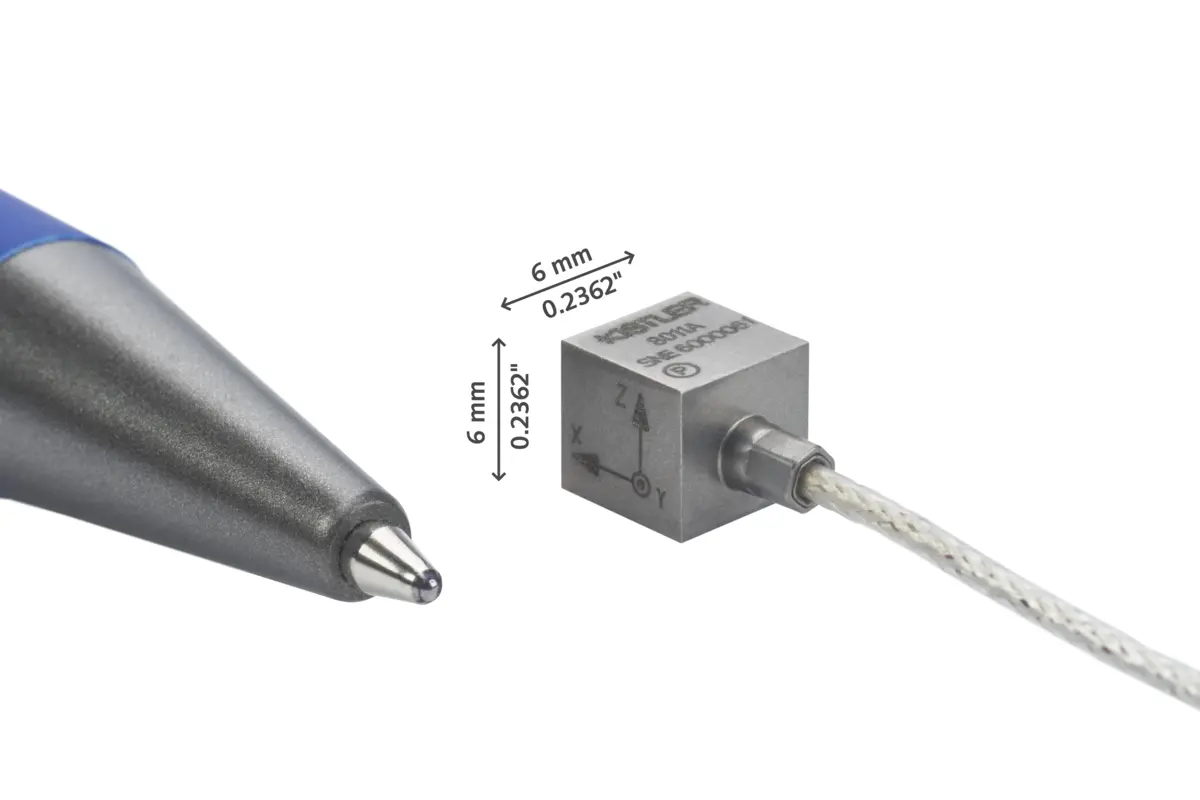
The product family Type Z22198 consists of the world's lightest miniature triaxial IEPE accelerometers which measure vibration in three orthogonal axes.
The Kistler Z22198E KiVibe Miniature is a triaxial IEPE accelerometer in a 0.236 in (6 mm) titanium cube weighing 0.0317 oz (0.9 g). It measures vibration in three orthogonal axes in ranges from ±100 to ±1,000 g, with a frequency response up to 10,900 Hz (±5%, Z axis). A PiezoStar crystal keeps thermal sensitivity shift low, and a case-isolated design keeps the signal stable near strong electromagnetic fields.
Four ranges: ±100, ±250, ±500, and ±1,000 g
Miniature and light: 0.236 in (6 mm) cube, 0.0317 oz (0.9 g); 0.3386 oz (9.6 g) total with cable and connector
Broad frequency range: up to 10,900 Hz (±5%, Z axis)
PiezoStar sensing element: typical thermal sensitivity shift ±5.0% from −67 to +257 °F (−55 to +125 °C)
Case-isolated design: low noise even with high electromagnetic interference
Integral flexible cable: 1.5 m (5 ft), 1/4-28 UNF 4-pin connector with TEDS
Low outgassing: sensor, cable, and connector conform to ECSS-Q-70-02
Main features / advantages
Low mass of 0.9 grams and miniature size of a 6 mm cube
Measurement range of 100 g, 250 g, 500 g, 1000 g
Extremely wide bandwidth from 0.3 to 10,900 Hz (±5%)
Minimal thermal sensitivity shift thanks to Kistler’s PiezoStar crystal technology
Low noise performance even at high electromagnetic interference thanks to internal ground isolation
Wide temperature range: -55 to +125°C (-67 to +257°F)
Swiss Made - highest quality and performance
What it is used for
Some of the use cases for the Z22198E include:
Structural dynamics testing — extremely small components, subsystems, and lightweight structures
Satellite testing and qualifying — where minimal size and weight are critical
Qualification testing — small components and systems
Noise, vibration, and harshness (NVH) testing
Electric motor testing and battery package testing and monitoring
Linear motor monitoring — precise optical alignment
Wafer handling and transport monitoring
Printed circuit board HALT/HASS and environmental stress screening (ESS)
Force-limited vibration testing (FLVT)
What does the Z22198E measure?
The Z22198E family consists of miniature triaxial IEPE accelerometers that measure vibration in three orthogonal axes. They are specifically designed for structural analysis of extremely small components, subsystems, and lightweight structures, such as satellites, where minimal size and weight are critical. They are widely used in aerospace, aviation, automotive, semiconductor, robotics, and other industries that need precise measurements in confined spaces.
The lightweight, flexible integral cable makes installation easy in confined or hard-to-reach spaces. It terminates in a four-pin industry-standard connector (1/4-28 UNF pos.) and includes a Transducer Electronic Datasheet (TEDS) for seamless system integration. A welded titanium housing adds durability while keeping the design lightweight.
With its case-isolated concept, the measuring signal stays largely unaffected even in strong electromagnetic fields, such as near electric motors or power electronics. At its core, the integrated PiezoStar sensing element offers exceptionally low thermal sensitivity shift, ensuring consistent performance across a broad temperature range, and combined with advanced IEPE electronics, it delivers a wide frequency bandwidth.
Why engineers pick it
Almost no mass loading. At 0.9 g for the sensor and 9.6 g including 1.5 m of cable and connector, the Z22198E barely changes the dynamics of small structures.
Stable over temperature. The in-house grown PiezoStar crystal holds typical thermal sensitivity shift to ±5.0% from −55 to +125 °C.
Clean signals near motors and power electronics. The case-isolated design keeps the signal stable in electrically noisy conditions. Magnetic field sensitivity is 0.05 mg/Gauss.
Space-ready materials. Sensor, cable, and connector meet low outgassing requirements per ECSS-Q-70-02.
Which Z22198E do I need?
Type
Range
Sensitivity (±35%)
Time constant, typ.
Frequency response ±5%, X / Y / Z
Z22198E100A
±100 g
49.9 mV/g
0.2 s
2.5 … 5,800 / 5,600 / 10,900 Hz
Z22198E250A
±250 g
16.6 mV/g
0.7 s
1.0 … 5,800 / 5,600 / 10,900 Hz
Z22198E500A
±500 g
7.7 mV/g
1.5 s
0.5 … 5,800 / 5,600 / 10,900 Hz
Z22198E1K0A
±1,000 g
3.6 mV/g
3.2 s
0.3 … 5,800 / 5,600 / 10,900 Hz
Stated sensitivity is the mean (nominal) value, with a ±35% spread. For example, the Z22198E1K0A has a mean sensitivity of 3.6 mV/g with a spread between 2.34 and 4.86 mV/g, giving a mean acceleration range of 1,388 g with a spread between 1,028 and 2,137 g. TEDS data (IEEE 1451.4 V1.0 Template 25) holds each sensor's actual values.
The higher ranges extend lower in frequency: the low-frequency limit (±5%) drops from 2.5 Hz on the ±100 g range to 0.3 Hz on the ±1,000 g range.
How is the Z22198E mounted?
For best performance, mount the accelerometer on its base plate on the component under test to achieve the optimum frequency response. Mounting on other sides reduces bandwidth and makes removal more difficult, so it isn't recommended. The surface must be smooth (<Ra 1.6), flat, and clean.
Room temperature tests: use the included petro wax (Type 8432)
Tests below or above room temperature: use adhesive bonds such as cyanoacrylate or speed bonder with a proper release agent. Kistler recommends Loctite 454 with release agent Type 1031.
Cable bending radius: minimum 6 mm for fixed installation, 12 mm for free movement
The accelerometer contains a high-output PiezoStar element combined with sensitive electronics. Handle it with care during mounting and removal, especially when removing a sensor attached with adhesive.
When is the Z22198E the wrong choice?
High X and Y bandwidth. The ±5% frequency response reaches 10,900 Hz only on the Z axis; the X and Y axes reach 5,800 Hz and 5,600 Hz.
Connector temperature. The sensor operates to +257 °F (+125 °C) and the cable to +338 °F (+170 °C), but the TEDS connector is limited to +5 … +176 °F (−15 … +80 °C) and must stay outside the hot zone.
Shock above ±2,000 g. The shock limit is 2,000 gpk.
Mounting on any face. Best frequency response needs mounting on the base plate.
Z22198E FAQ
±100, ±250, ±500, and ±1,000 g.
A 6 mm (0.236 in) cube weighing 0.9 g (0.0317 oz). Including the 1.5 m cable and connector, the total mass is 9.6 g (0.3386 oz).
Up to 10,900 Hz (±5%) on the Z axis, and 5,800 Hz and 5,600 Hz on the X and Y axes.
Sensor, cable, and connector conform to the low outgassing requirements of ECSS-Q-70-02, and low-outgassing breakout cables are available. Satellite testing and qualifying is a primary application.
Yes. The connector carries a TEDS per IEEE 1451.4 V1.0 Template 25, readable by any TEDS-compatible data acquisition system.
Use an adhesive such as cyanoacrylate with a release agent. Kistler recommends Loctite 454 with release agent Type 1031.
A 1756CxK04 or 1734AxK04 breakout cable to a LabAmp Type 5165A, or to a KiDAQ Type 5500A data acquisition system with IEPE module 5512A, analyzed with KiStudio Lab or jBEAM Lab.
Configure and order the Z22198E
Choose the Z22198E range and breakout cable your test needs and order directly on this page. For questions, contact us.
Downloads
Kistler - Z22198: 3-Axis Accelerometer Family (Ultra-Lightweight)